

Private school soccer is a meaningful commitment. Unlike joining a club team, it brings school, training and support together. It can give a young player more coaching, a clearer routine and an environment built around development. It can also add travel, expense and pressure to a family's week. The right answer is whether that environment is worth it for your player, at this stage, with your family's goals and resources in mind.
A good decision starts by stepping back from the highlight clips and big promises. The question is not simply whether a program has a strong name, a nice field or a busy match calendar. It is whether the player will be coached well, supported as a student, challenged without being overwhelmed and given a routine that the family can sustain. This guide gives parents a practical way to make that call.
1. Decide what "worth it" means for your family
Families often use the same phrase to mean different things. One family may be looking for technical coaching and more serious competition. Another may need a school day that leaves room for training, strength work and recovery. A player may want a new challenge, while a parent may be trying to reduce the stress of balancing multiple teams, training sessions and school deadlines.
Put the goal into plain language before comparing programs. Does your player need a more demanding environment, a more consistent routine or better support through a transition? Are they hoping to explore college soccer, develop confidence or simply enjoy the game in a stronger setting? There is no universal right answer, but a specific goal makes it much easier to recognize a good fit.
It also helps to name the tradeoff honestly. More training is not automatically better. A player who is already tired, disconnected from school or losing enjoyment may need a different solution than a fuller schedule. A worthwhile academy should help a young person grow over time, not ask them to prove themselves every day.

2. Look at the whole week, not one training session
A visit can show you the energy of a training session. It cannot, by itself, show you the routine that shapes a player's development. Ask to see a normal week. Include school hours, training, strength sessions, matches, travel, meals, recovery time and the moments when a student can complete schoolwork. The routine is where a program either becomes sustainable or starts to strain the family.
This matters because young players do not experience soccer in isolation. They have homework, friends, family responsibilities and a need for sleep. When a schedule leaves no room to recover, organize schoolwork or simply reset, even an exciting program can become difficult to maintain. The most useful academy decision is usually the one that makes the full week more coherent, not the one that fills it with the most activities.
Ask direct questions. What does a regular Monday look like? How often do players train? When are matches played? Who communicates schedule changes? What happens when a tournament, travel day or school assessment creates a conflict? A program that knows its own rhythm should be able to answer without vague promises.
Families considering a school-based option can use Brooke House Academy's daily schedule as a useful example of the detail to look for. The exact plan will vary by age and location, but you should be able to see where learning, training and recovery fit together before making a commitment.
3. Evaluate the coaching environment, not just the coach's resume
A recognizable playing background can be interesting, but it does not tell you everything about a player's daily experience. Watch how coaches teach. Are instructions clear? Do players understand the purpose of a drill? Is feedback specific enough for a young person to act on? Do coaches demand effort while still helping players recover from mistakes?
The best environment for development is not one where every player is praised constantly, and it is not one where players are afraid to take responsibility. It is one where standards are clear, effort is noticed and mistakes become information for the next action. U.S. Soccer's guidance on assessing players and their environment makes a similar point: development depends on the player and the setting around that player, not one isolated moment.
During a visit, notice what happens after an error. Does the coach give a useful correction? Do players keep working? Is there room for questions? Also look at how the group treats one another. A serious environment can still be respectful. The culture around mistakes, effort and communication has a larger effect on a young player than a dramatic first impression.
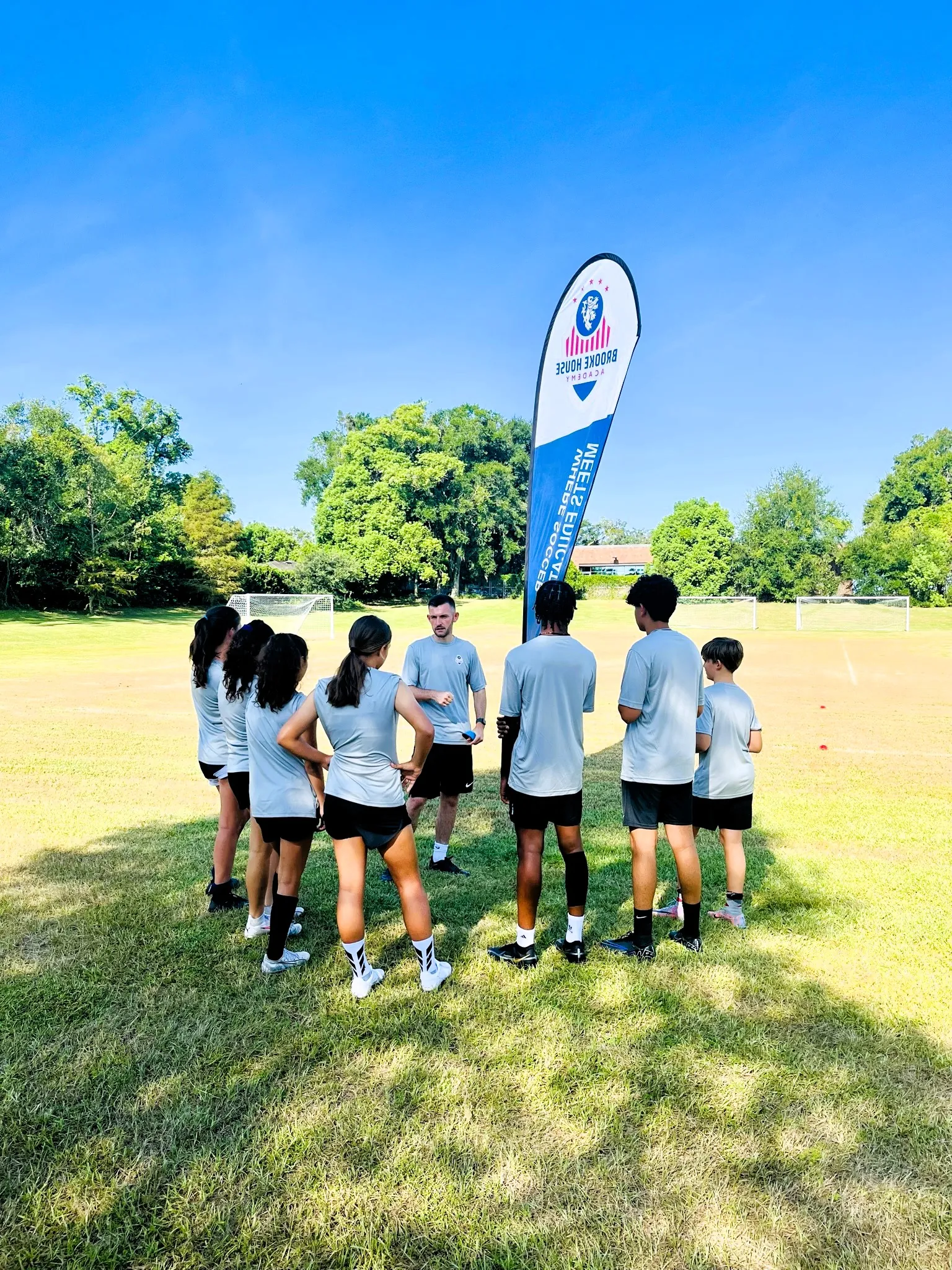
Take time to meet the people who will be present every week, not only the person speaking during the tour. Brooke House Academy families can get to know the coaching team and ask how player feedback, individual development and family communication work in practice.
4. Treat school as part of the decision
For a student-athlete, the quality of the school plan matters as much as the quality of the training. A strong academy gives families a clear answer to basic questions: who supports students during the school day, how progress is tracked, what happens around travel, and how a student catches up after a difficult week. If the answer is only "they will figure it out," keep asking.
Academic consistency keeps options open. Players who may later consider college soccer need to protect their school record alongside their development on the field. The NCAA's initial-eligibility guidance is a useful reminder that athletic ambition and academic preparation have to move together.
This does not mean every student needs the same academic schedule. Some thrive with a predictable classroom routine. Others need a little more flexibility around training, travel or the pace of a subject. What matters is that the program understands the difference and can explain how it supports the student in front of it. Review the school's academic approach and ask where teachers, study time and communication fit into a normal week.

5. Count the commitment honestly
Cost is part of the decision, but it is not limited to tuition or team fees. Families should consider travel, equipment, meals away from home, transportation, time away from work and the practical cost of a fuller weekly schedule. A transparent program should make it easy to understand what is included, what may change and when those costs are due.
Time has a value too. Some families find that a more complete academy routine reduces the constant running between school, training and extra sessions. Others may discover that the travel or weekly commitment is not realistic right now. Neither conclusion is a failure. The useful thing is finding it out before enrollment rather than after a player is already stretched thin.
Write down your questions before a visit. Ask for current tuition, payment timing, possible support, expected travel and anything a player will need beyond the stated program. Brooke House Academy's tuition and financial aid page explains where families can get current information, while a tour can help clarify the day-to-day commitment for a particular campus.
Avoid making a decision from a single total. Two programs with similar stated costs can ask very different things from a family through the year. One may include most training, coaching and facility time in a school-day routine. Another may require separate sessions, travel commitments or frequent add-ons. Ask for a current breakdown, then ask what a typical season requires beyond that breakdown.
This is also a good time to discuss the family calendar. Who can handle transportation? How will siblings, work and weekend plans be affected? Is there a busy period in the school year when the schedule will need extra attention? The goal is not to find a program with no tradeoffs. It is to choose one whose tradeoffs your family can handle without constant friction.
6. Ask who is responsible for each part of development
A player's progress comes from more than the scheduled sessions. Someone needs to notice how the player is responding, help them set useful goals and keep the pieces of the week connected. That does not mean an academy should take over every decision a family makes. It means the responsibilities should be clear enough that the player does not fall between the gaps.
Ask who leads the player's soccer development and how often that person sees them. Ask how a coach shares feedback with the player, whether goals are revisited and what happens when a player is injured, losing confidence or adjusting to a new level of competition. The answer should explain a real process, not just say that every player receives individual attention.
The same applies to physical development. Strength, speed and recovery work can help a player when they suit their age, training load and current needs. They can become noise when they are simply added on top of an already crowded week. Families should ask when performance work happens, who guides it and how it changes around matches, school demands and a player's recovery.
Finally, ask how the program communicates with home. Families do not need a message after every session, but they should know who to contact, when meaningful feedback is shared and how concerns are handled. Clear communication reduces uncertainty and helps a player hear the same priorities from the adults around them.
7. Build a simple comparison scorecard
A scorecard keeps a family from choosing on emotion alone. It does not need to be elaborate. After every visit or call, write down what you learned under the same headings. Give each area a plain description such as strong, unclear or not a fit. The notes will be much more useful a week later than a memory of the loudest training session or the nicest facility.
- Player fit: Is the challenge right for the player's current level and personality?
- Coaching: Do the coaches teach clearly, set standards and give useful feedback?
- School: Is there a credible plan for learning, support and communication?
- Weekly rhythm: Can the player train, recover and keep up with normal family life?
- Culture: Does the environment feel ambitious, respectful and safe?
- Cost and travel: Are the financial and practical demands clearly explained?
- Next step: Does the program help the player build toward a realistic goal?
Keep the player involved in the discussion, but do not ask them to carry the full decision. A young person may be drawn to the players, field or intensity of a visit. Parents can add the context that only they can see: school needs, travel, cost, family logistics and whether the opportunity still makes sense after the excitement wears off.
It can help to compare an academy against the player's current situation, not an imaginary perfect alternative. What is working now? What is missing? What would actually improve if the player changed programs? This keeps the choice anchored in the player's next stage instead of a fear of being left behind.
8. Compare the alternatives fairly
Private school soccer is not the only worthwhile route. A club team can be a strong fit when a player has a stable school routine, enjoys their current environment and needs a more flexible commitment. Private training, camps or an additional strength plan may also help a player address a specific goal without changing every part of their week.
A school-based academy can make more sense when the family wants academics, training, performance work and player support to operate as one plan. The difference is not a label. It is whether the environment solves a real problem for the player and helps the family build a more sustainable routine.
Use the same comparison questions for every option. Who is responsible for development? What does the week look like? How are school needs handled? What feedback does the player receive? What happens after a setback? The Academy's guide to choosing a soccer academy in Florida offers a practical checklist for keeping that comparison focused on the details that matter.
Do not assume that a change is urgent because other players are making one. Development is rarely a straight line, and the best setting can change as a player grows, gains independence or faces a new academic demand. The useful decision is the one that fits now while leaving room for the player to keep learning.
9. Know when private school soccer may not be the right move yet
It is reasonable to decide that private school soccer is not the right move right now. A player may be recovering from injury, adapting to a new school, rebuilding confidence or still enjoying a club environment that meets their needs. Families do not need to make a larger commitment just to keep pace with other players. The right timing is part of the decision.
Be cautious when a program creates urgency without giving clear answers. A family should not feel pushed to commit before they understand the school plan, costs, weekly rhythm and expectations. Serious opportunities can stand up to thoughtful questions. A good program wants the right players and families, not a rushed yes from anyone who attends a session.
It may also be worth pausing when the player cannot explain what they hope will improve. "Everyone else is doing it" is understandable, but it is not a strong reason for a major change. A player who can name a goal, such as becoming more consistent, finding a better school-training balance or being challenged in a new environment, has a clearer basis for evaluating whether an academy can actually help.
Choosing to wait does not close the door. A family can revisit the question after a season, arrange a visit, attend a tryout or ask what preparation would make a future transition more useful. Development has room for different routes, and a thoughtful decision today can create a better opportunity later.
10. Let the player's response matter
Parents should lead the decision, but a player's response contains useful information. After a visit, ask what felt challenging, what felt enjoyable and whether they could picture themselves returning. Listen for more than excitement. Did they understand the coaching? Did they feel comfortable asking a question? Were they energized by the standard, or simply intimidated by it?
The answer may not be immediate. A new environment can feel uncomfortable at first, especially for a player who cares deeply about the opportunity. Give the conversation room. A strong choice usually becomes clearer when the family can name both the opportunity and the tradeoff without trying to talk either one away.
A tryout or training visit can help make the decision more concrete. Read the Academy's parent guide to soccer academy tryouts for practical ways to prepare and observe the experience without adding extra pressure.
Give yourselves permission to take a little time when the decision allows it. A second visit, a conversation with the academic team or a chance to watch a normal training session can answer questions that a polished tour cannot. The more important the commitment, the more valuable it is to see the program in ordinary conditions.
11. Make a decision your family can support
The best academy choice is one the family can support long after the first visit. That means the player understands why they are making the change, the adults around them can manage the rhythm and the program has earned trust through clear answers. It does not require certainty about every future outcome. It requires enough clarity to begin with purpose.
Before making a final decision, talk through the first few weeks. What will the morning routine look like? When will homework happen? How will the player get to training and recover after a demanding day? Who will you contact with a question? Small practical answers are often a better indicator of fit than big claims about the future.
Then agree on what success will look like at the end of the first term or season. It may be better habits, stronger confidence, improved school organization, more useful coaching feedback or a clearer understanding of the player's next step. A reasonable definition of success gives the family a way to evaluate the decision without expecting instant results.
Keep that conversation open after enrollment too. Check in with the player regularly, especially during the first adjustment period. Ask what is becoming easier, what still feels demanding and whether the original goals still make sense. Good communication gives a family the chance to solve small problems early, before they turn into frustration or a decision made in the middle of a difficult week.
The right program should welcome that kind of involvement. A player needs room to take ownership, while parents need enough visibility to support school, well-being and the practical realities of a busy schedule. When those roles are clear, private school soccer can become a steady part of a young person's development instead of a source of unnecessary pressure.
That steadiness is often the clearest sign that the investment is serving the player well.
How Brooke House Academy can help
Brooke House Academy brings academics, soccer development, strength and conditioning, and personal growth into one school-day environment for student-athletes in grades 6-12. Families can explore the football pathways, review the Florida campus options and see how the Academy connects ambitious players with a broader future in the game through Brooke House FC.
The best next step is a straightforward conversation about your player's goals, current routine and what your family needs. Read what a soccer academy is for a foundation, then book a tour or ask a question when you are ready to see the environment for yourself.
Frequently asked questions
Is private school soccer right for every player?
No. It can be a strong fit for a player who wants more coaching, a dependable routine and a school plan that works alongside training. A player who enjoys their current team, needs a lighter commitment or is not ready for a major schedule change may be better served by staying where they are.
What should families compare before choosing a soccer academy?
Compare the full week, not just the field session. Ask about coaching, school support, travel, strength work, recovery, communication, cost and the next step for players at a similar age. Then consider whether that routine fits your child and your family.
How much time does private school soccer take?
The commitment varies by program. Families should ask for a normal weekly schedule, including school hours, training, matches, strength sessions, travel and recovery. A clear answer is more useful than a brochure because it shows what daily life will actually feel like.
Can a student-athlete balance private school soccer and academics?
They can when the program makes room for both. The key questions are who monitors schoolwork, how missed work is handled, when students study and how the schedule changes around travel or assessments. A serious academy should be ready to explain those details clearly.
Continue your research.

What Is a Soccer Academy? A Parent’s Guide
Learn what a soccer academy is, how it works, how it compares with club soccer, and what parents should look for in a player-development program.
Read the guide →
How to Get Into a Soccer Academy: A Parent Guide
A practical guide to preparing for a soccer academy, from goals and research to tryouts, school planning and the first family conversation.
Read the guide →
Soccer Academy Tryouts: A Parent Guide
What soccer academy tryouts involve, what coaches look for, and how families can prepare without adding unnecessary pressure.
Read the guide →